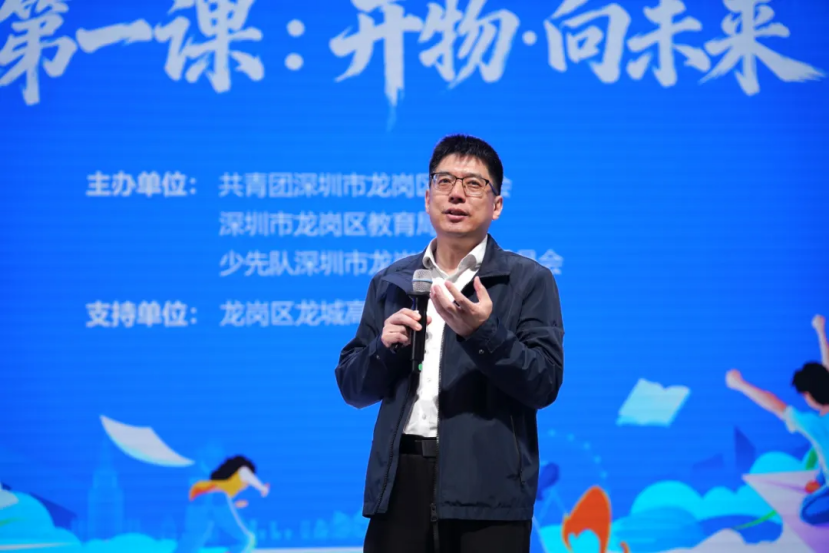
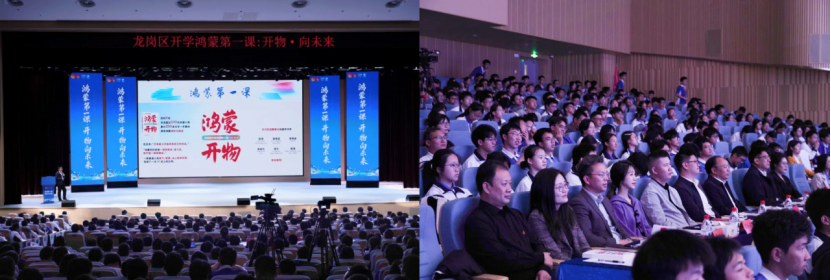
On 9 March, Fang Xingdong, Executive Vice-President of the College and Director of the Hangzhou Xiaoshan Airport Intelligent Media Research Institute, was invited to deliver the ‘First HarmonyOS Lesson of the New Term’ in Longgang District, Shenzhen. Nearly a thousand teachers and students attended the event in person, whilst all universities, secondary schools and primary schools across the district will participate in a centralised online session during form periods and team classes.
This event was jointly organised by the Longgang District Committee of the Communist Youth League, the District Education Bureau and the District Working Committee of the Young Pioneers. It aimed to actively respond to the District Committee’s strategic deployment for building a “HarmonyOS District”, to promote the deep integration of the HarmonyOS ecosystem with the ideological and political guidance of young people and science and technology innovation education, and to guide young people to engage with, understand and embrace HarmonyOS.
Shenzhen’s Longgang District is currently coordinating resources from all sectors to build a ‘HarmonyOS Zone’ that operates across the entire district and around the clock. The district has already attracted more than 110 enterprises related to the HarmonyOS ecosystem. The “HarmonyOS Ecosystem Core Cluster” in Bantian and the “HarmonyOS Ecosystem Application Cluster” in Dayun are rapidly taking shape, with 11 HarmonyOS parks and five HarmonyOS buildings currently being planned and constructed. Over the next three years, more than 10 billion yuan in special funds will be allocated to prioritise the procurement of HarmonyOS-enabled technology products, whilst industry application examples such as “Police Harmony”, “Construction Harmony”, Transport Harmony” and “Power Harmony”, are continuously emerging.
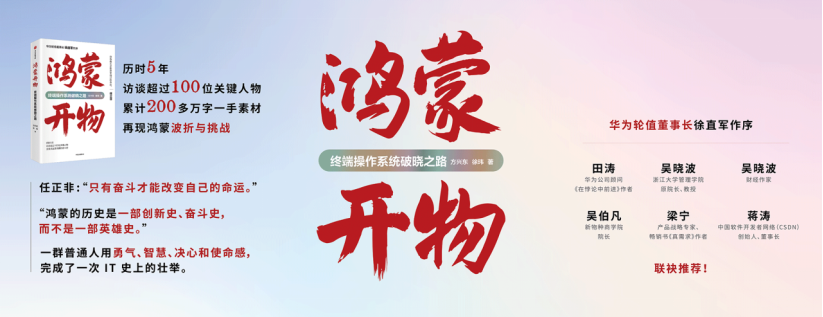
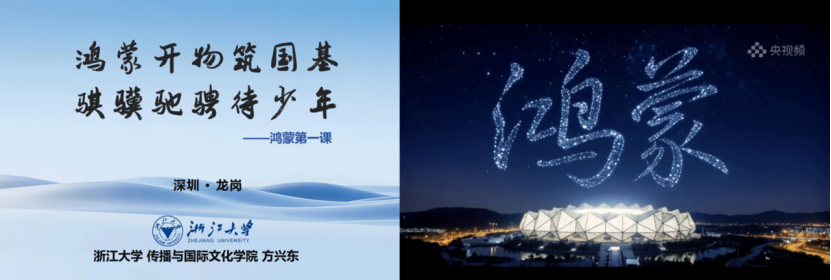
Over the course of five years, Fang Xingdong conducted in-depth interviews with more than 100 key members of Huawei’s HarmonyOS core team, amassing nearly 2 million words of first-hand material to provide a comprehensive account of HarmonyOS’s journey from conception to reality. Through a series of vivid stories, HarmonyOS has transformed from a cold technical concept into a warm and powerful chronicle of China’s technological endeavours. By interpreting the phrase ‘chaos gives way to order, the universe takes shape’ (混沌初开,乾坤始奠), he explores the profound aspirations for HarmonyOS as the ‘autonomous foundation’ of Chinese technology; and through the analogy that ‘to build a house, one must secure one’s own foundations’, he elaborates on the vital significance of ‘autonomy and controllability’ for the nation’s technological development.
During the lecture, Fang Xingdong also shared the true stories behind HarmonyOS’s development: he looked back on the decision to take the difficult yet correct path during the ‘single-framework versus dual-framework debate’; recounted the intergenerational legacy of veteran research experts and young engineers working hand in hand to overcome challenges; and detailed the R&D team’s steadfast perseverance in the face of adversity.
Currently, the HarmonyOS ecosystem is evolving from being merely available to being truly user-friendly. The number of devices running HarmonyOS 5 and HarmonyOS 6 has surpassed 45 million, with over 75,000 native applications and cloud services available. It has also been widely adopted across sectors such as finance, electricity, energy, transport and telecommunications.
The HarmonyOS system was ‘born and raised in Shenzhen’; it is not merely a mobile operating system, but a digital foundation for a wide range of industries. As one of the areas in Shenzhen with the highest concentration of manufacturing, Longgang has established a systematic framework spanning technological breakthroughs, industrial clustering, scenario-based applications and ecosystem collaboration.
The emergence of any new industry requires the coordinated development of upstream and downstream enterprises, the support of a diversified industrial landscape, and is inseparable from the catalysis of application scenario innovation, as well as the safeguards provided by institutional mechanisms. Longgang positions itself as the “pilot zone” for open-source HarmonyOS, as well as the “testing ground” and “incubator” for its ecosystem. For Longgang, HarmonyOS is not merely a technological innovation in operating systems, but a key engine driving the restructuring of the regional industrial ecosystem and the upgrading of its systems.
The atmosphere at the lecture was electric, with Fang Xingdong telling the students: “The heart of HarmonyOS is beating strongly right here in Longgang.” He added: “This is the core stronghold for the development of HarmonyOS; you are not merely witnesses, but can also become active participants. I hope that, with the spirit of a fine steed, you will shoulder the heavy responsibility of serving the nation through technology, and become the new generation of forces that will lay a solid foundation for HarmonyOS and drive the development of Digital China.”